

Finish Carpentry and Custom Cabinetry Cost in Austin TX

When homeowners search for finish carpentry and custom cabinetry cost in Austin TX, they are usually trying to answer a practical question: what belongs in the budget, and how can they compare quotes without missing important work? The honest answer is that custom finish work does not have one universal price. The scope, materials, design detail, existing walls, access, and installation sequence all matter.
A good estimate turns those variables into a clear scope instead of a vague allowance. This guide explains what finish carpentry and custom cabinetry include, what drives the cost of each, and what Austin homeowners should ask before work begins.
What do finish carpentry and custom cabinetry include?
Finish carpentry and custom cabinetry are the detail trades that make a renovation look complete and work properly. Finish carpentry can include trim, baseboards, casing, crown molding, doors, built-ins, shelving, and other precise woodwork. Custom cabinetry includes planning, fabrication, delivery, installation, adjustment, and finish details for storage that is made for a specific room.
The two scopes often overlap. A cabinet project may need finished end panels, filler pieces, crown detail, scribe strips, toe kicks, or trim where the cabinets meet a wall, ceiling, flooring, or adjacent door. A finish carpenter may also build a bench, mudroom storage, media wall, or other built-in that is not part of a kitchen cabinet package.
- Finish carpentry:
trim, molding, doors, built-ins, shelving, and detail work.
- Custom cabinetry:
made-to-measure boxes, doors, drawers, hardware, panels, and storage features.
- Installation coordination:
field measurements, layout checks, leveling, scribing, and final adjustments.
- Related trades:
drywall, painting, countertops, flooring, tile, plumbing, or electrical work when the room changes around the cabinets.
Rhino Renovations lists finish carpentry and cabinetry among its core specialties, along with drywall, painting, countertops, tile, and flooring. That broader trade coverage matters when the finished result depends on several crews working in the right order.
How is finish carpentry and cabinetry cost determined in Austin?
Finish carpentry and cabinetry cost in Austin is determined by the complete scope, not by the cabinet boxes or trim alone. A useful proposal separates design and measurement, materials, fabrication, delivery, installation, finish work, demolition, disposal, and any related trade coordination. This makes it easier to compare two estimates that may appear different at first glance.
Cost factor | What to clarify in the estimate |
Project scope | Which rooms, walls, cabinets, trim profiles, built-ins, and punch-list items are included? |
Materials | What species, sheet goods, paint or stain system, doors, drawer construction, and hardware are specified? |
Design detail | Are there curves, specialty storage, inset doors, integrated panels, tall units, or unusually tight tolerances? |
Site conditions | Are walls out of square, floors uneven, ceilings inconsistent, or access limited? |
Related work | Will drywall, painting, countertops, flooring, tile, plumbing, or electrical changes be completed by the same team? |
Schedule | Are materials available, and how will fabrication and installation fit the renovation sequence? |
Online cost guides can be useful for learning the vocabulary, but broad market figures are not a Rhino Renovations quote. For a real project, an on-site evaluation is more useful than a generic calculator because it accounts for the actual room, finish level, and work required.
What makes custom cabinetry more expensive than stock cabinets?
Custom cabinetry costs more than stock cabinets because it is designed and built around the room instead of selected from fixed sizes. The added value is not only the cabinet door style. It can include better use of irregular walls, taller or deeper storage, tailored fillers, specialty drawers, integrated panels, and a finish selected for the rest of the renovation.
Stock cabinets can be a practical choice when standard sizes fit the room and the layout does not need unusual storage. Semi-custom options may provide more door, finish, and size choices. Fully custom work is most useful when the room has difficult dimensions, a distinctive design goal, or storage needs that standard units cannot meet. Rhino Renovations also provides kitchen remodeling services for homeowners planning cabinetry as part of a larger room update.
Ask whether the proposal includes the details that are easy to overlook: finished sides, crown, light rails, toe kicks, filler panels, finished backs, hardware, delivery, installation, and final adjustment. Two bids can use the word custom while including very different levels of completion.
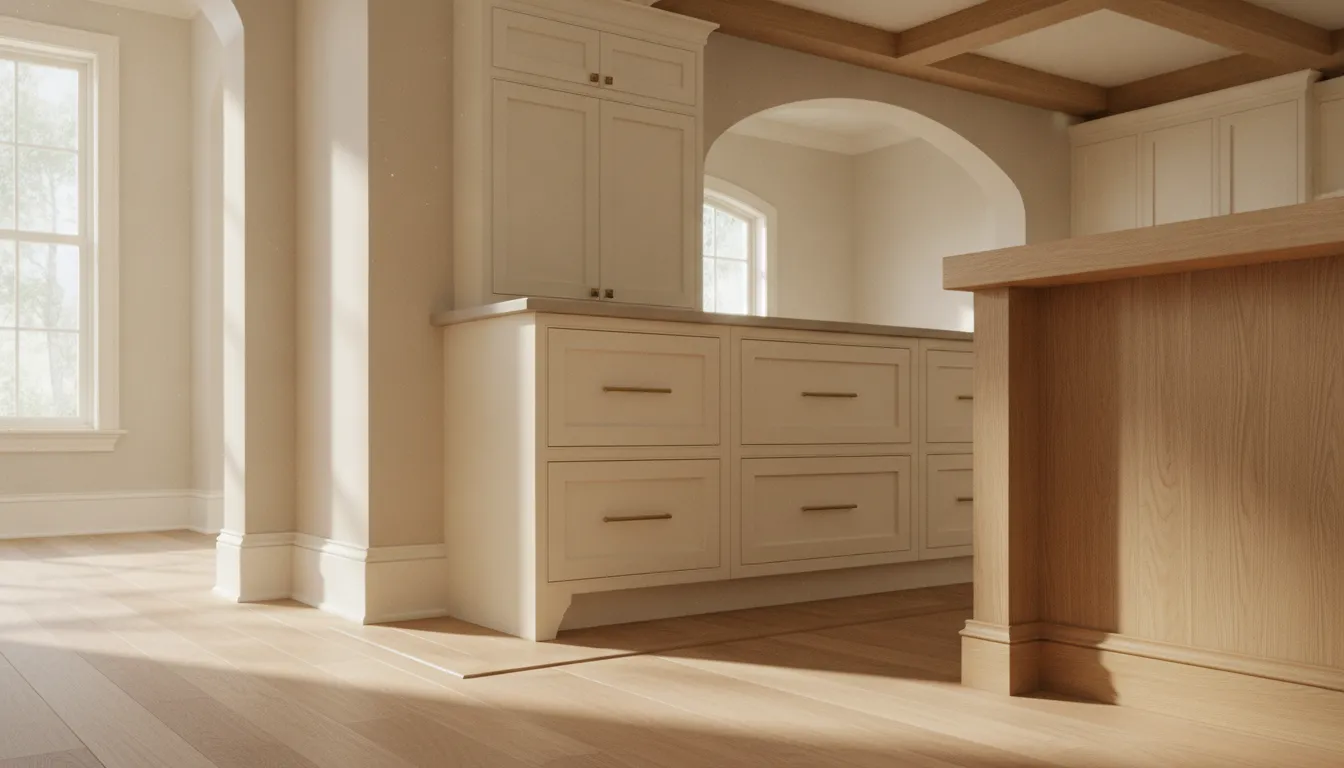
Small details such as scribing, trim transitions, and hardware alignment shape the finished result.
Which trim and molding details affect a renovation quote?
Trim cost changes with the profile, material, number of corners, wall conditions, and amount of fitting required. Straight baseboards in a newer room are a different scope from matching a historic profile, wrapping multiple doorways, or fitting crown molding against an uneven ceiling.
In Austin homes, the existing conditions can be as important as the selected product. Older homes may have walls that are not perfectly plumb or square. Remodels can also reveal drywall transitions, flooring height changes, or previous trim layers that need to be removed or repaired. A careful installer measures those conditions before promising a clean line.
- Profile matching:
matching existing casing or molding may require a custom millwork profile or careful transition.
- Corner count:
more inside and outside corners create more layout, cutting, and fitting time.
- Wall and ceiling condition:
uneven surfaces may require scribing, caulking, repair, or a revised detail.
- Finish level:
paint-grade and stain-grade work have different preparation and finishing requirements.
- Removal and disposal:
old trim, adhesive, and damaged material need to be included if they must come out first.
Rhino Renovations can coordinate finish carpentry with drywall, painting, flooring, and other interior trades. That helps reduce the risk of one crew finishing against conditions another crew still needs to change.
How does project sequencing affect cabinetry and finish work?
Cabinetry and finish carpentry should be scheduled after the room is ready for accurate measurements and before the final detail work is complete. The exact sequence depends on the project, but planning usually includes a site review, measurements, design decisions, material ordering, preparation, installation, countertop coordination when applicable, painting or finishing, and a final walkthrough.
- Define the scope:
decide what the room needs to accomplish and which existing materials will stay.
- Inspect the site:
check walls, floors, ceilings, utilities, access, and any damage or repair conditions.
- Confirm the design:
approve the layout, storage features, trim profile, finish, hardware, and responsibilities for related trades.
- Coordinate materials:
confirm lead times and protect the schedule from avoidable delivery gaps.
- Prepare the room:
complete the required demolition, drywall, flooring, plumbing, electrical, or structural work before installation.
- Install and adjust:
set the cabinets or built-ins, complete trim, scribe to the room, align doors and drawers, and address punch items.
Cabinet installation should be complete before countertop templating when the countertop depends on the actual installed conditions. Finish carpentry then helps create clean transitions around cabinets, doors, windows, and flooring. The broader Austin home renovation planning guide explains why trade coordination belongs in the scope from the beginning.
Do finish carpentry projects need permits in Austin?
Permit requirements depend on the work being performed, not simply on whether a project includes cabinets or trim. Cosmetic finish work may be treated differently from a project that changes structure, electrical, plumbing, mechanical systems, or other regulated elements. Because the details vary, homeowners should confirm the requirements for their exact scope before demolition or construction.
The City of Austin Development Services Department provides construction and permitting guidance, and its Do I Need A Permit? tool can help homeowners start the review. Treat the tool as a starting point and confirm the result with the city when the project is complex.
Ask the contractor to identify who is responsible for permits, inspections, and coordination with licensed trades. A cabinet installation that also moves a wall, sink, outlets, gas lines, or HVAC components is a different project from replacing doors and hardware within an existing layout. Rhino Renovations explains its broader approach on the about page, including the value of clear communication and dependable workmanship.
What should Austin homeowners ask before accepting a quote?
The best quote is specific enough that you can understand what will be built, what will be supplied, and what is excluded. Before accepting an estimate, ask questions that turn a broad promise into a shared scope of work.
Is the proposal for stock, semi-custom, or fully custom cabinetry?
Which materials, finishes, hardware, and construction details are included?
Are measurements, design revisions, delivery, installation, and final adjustments included?
Which trim, filler, panel, crown, toe-kick, and scribe details are included?
What demolition, disposal, drywall repair, painting, flooring, or countertop work is included?
Who coordinates permits, inspections, utilities, and other trades if the layout changes?
What could change the scope after walls, floors, or old cabinets are opened?
What is the expected sequence, and what decisions must be made before materials are ordered?
Ask for a written scope rather than comparing only a bottom-line number. Clear documentation protects the homeowner and the contractor because both sides can see which assumptions shaped the estimate.
Frequently Asked Questions
How much does custom cabinetry cost in Austin?
Custom cabinetry in Austin does not have one reliable price for every home. The final cost depends on cabinet size and layout, materials, finish, hardware, storage features, site conditions, installation, and related trade work. Rhino Renovations can review the project and explain the scope during a free consultation, including when cabinetry is part of a bathroom remodeling project.
Is finish carpentry different from cabinet installation?
Yes. Cabinet installation places and adjusts cabinet units, while finish carpentry includes detail work such as trim, molding, doors, built-ins, shelving, and transitions. The scopes can overlap when cabinets require finished panels, crown, fillers, or scribing. Homeowners comparing a cabinet change with a larger renovation can also review Rhino Renovations' cabinet replacement and refacing guide.
Can Rhino Renovations provide a cost estimate without visiting the home?
A conversation can clarify goals, but an on-site evaluation is the best way to understand existing conditions and build a useful scope. Walls, floors, access, damage, utilities, and the relationship between trades can all affect the work.
When should cabinets be installed during a remodel?
Cabinets are generally installed after the room is ready for accurate measurements and before dependent work such as countertop templating. The exact sequence changes with the project, so the contractor should coordinate preparation, installation, finish work, and the final walkthrough.
How do I start a finish carpentry or cabinetry project in Austin?
Start by listing the room, storage goals, preferred finish, existing problems, and any related remodeling work. Then contact Rhino Renovations for a free, no-obligation on-site evaluation and a clearer plan for the next steps.
Rhino Renovations provides finish carpentry, cabinetry, and related remodeling trades for Austin and Round Rock homeowners. Visit the specialties page to see the broader service offering, or review the projects page before reaching out. A clear scope is the best first step toward a finished result that looks intentional and holds up.


Comments